






Lofoten Cycling Tour
Luggage transfer
Midnight sun/Northern Lights
Spectacular scenery
Picturesque fishing villages
Optional activities
7 x accommodation | 7 x breakfast | 6 x self-packed lunch | 3 x dinner | Bicycle ferry | Luggage transfer (1 item pre person) | Greenfee discount - Lofoten Links | Tour description | App with access to maps, tracks, vouchers and all necessary travel documents
This tour must be booked no later than 60 days prior to departure.
Cycle from Svolvær to Reine through the spectacular landscapes of Lofoten. The route is designed to let you experience as much of the islands as possible on two wheels, passing fishing villages, beaches, fjords and dramatic mountain scenery along the way.
Cycling Through the Lofoten Islands
The route takes you through some of Lofoten’s best-known places, including Henningsvær, Hov, Nusfjord and Reine. Wherever possible, we choose quieter roads away from the main route, although some sections on busier roads are unavoidable.
The cycling stages give you time to stop along the way, explore local communities or add activities such as hiking, kayaking or fishing.
Different Places to Stay Along the Route
Because the tour is designed around the best cycling route rather than a fixed type of accommodation, places to stay vary between traditional fishermen’s cabins, hotels and lodges. Each destination offers its own character and gives you a different perspective on Lofoten.
Your luggage is transferred between accommodations, so you only need to carry what you need for the day.
When to Cycle in Lofoten
Lofoten is particularly busy from June to mid-July, when the Midnight Sun attracts many visitors. For fewer tourists and generally quieter roads, we recommend early June or late August and September.
Early summer brings long days and bright Arctic landscapes, while late summer and autumn offer crisp air, changing colours and increasingly dark nights. You may even experience the Northern Lights.
A self-guided cycling journey through Lofoten, designed to help you experience the islands, landscapes and local communities at your own pace.
Part of the route follows the Norwegian Scenic Route Lofoten and parts follows the signposted National Cycle Route 1 (The coastal route) and EuroVelo 1 (Atlantic Coast Route).
Book your Lofoten cycling tour with Discover Norway!
Our bike tour in the Lofoten Islands was a wonderful experience. Pure nature, beautiful dry weather and excellent organization. Everything went perfectly.
Luggage transfer
Midnight sun/Northern Lights
Spectacular scenery
Picturesque fishing villages
Optional activities
7 x accommodation | 7 x breakfast | 6 x self-packed lunch | 3 x dinner | Bicycle ferry | Luggage transfer (1 item pre person) | Greenfee discount - Lofoten Links | Tour description | App with access to maps, tracks, vouchers and all necessary travel documents
This tour must be booked no later than 60 days prior to departure.
-
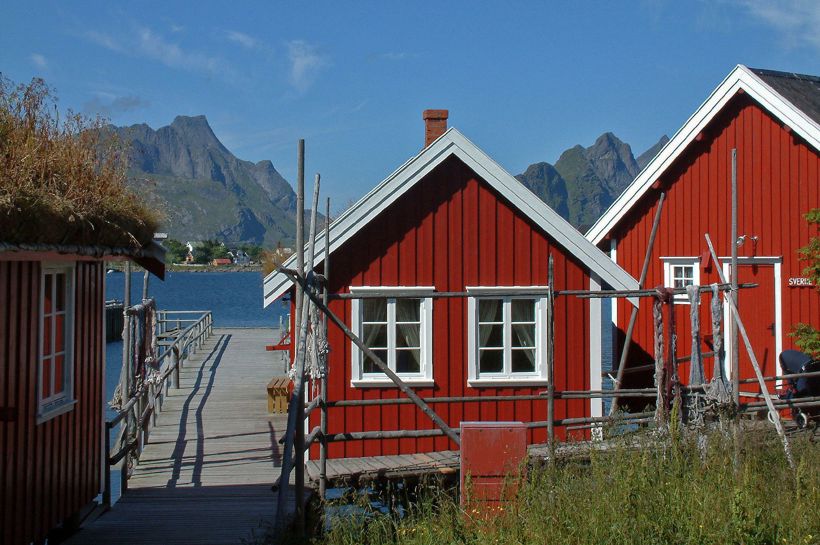 Photo: Classic Hotels Norway

Number of participants:
2 - 16 people on each departure
Price per person 2026:
NOK 25,600.- in a doubleroom
Single room supplement:
NOK 11,800.- (single room on request only)
Extra:
Topographic map: NOK 350.-
2 hr sea kayaking from Svolvær NOK 1,095.- per person
Sea Eagle RIB safari to Trollfjorden (from Svolvær): NOK 1,350 per person
Bike rental 7 days, including return transport from Reine:
Touring/trekking bike incl. double pannier: NOK 3,500.-
E-bike incl. double pannier: NOK 5,500.-
All bikes will come with a bottle holder, front/back lights, pump, spare inner tube, puncture repair kit, High visibility vest and a helmet.
Not included in the price:
Travel- and cancellation insurance
Beverages, snacks
Dinner in Svolvær and Leknes
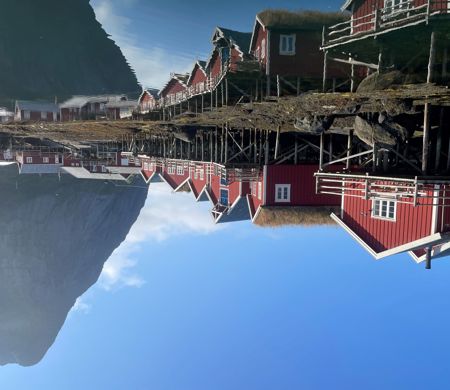
In Reine, you stay in rorbu cabins. Please be aware that you have to share the cabin (bathroom, living room etc.) with others, who have booked the same trip with Discover Norway. When you stay overnight in Rorbu Cabins you get your own sleeping room in accordance with your booking.
Please note that most 2-bedroom comfort cabins feature one larger double bedroom and a second, smaller bedroom with either a bunk bed or two single beds in the loft, and one bathroom.
Lofoten is a very attractive holiday destination during the summer season, and it is hard to get accommodation. Unfortunately, we are not able to offer one fisherman's cabin for each booking.
History
It all started in the 1100s, as King Øystein Magnusson built so-called rorbu cabins and a church for the fishermen of Vågan. This tells us that even a thousand years ago, the Lofoten Fishery was of considerable importance, and that the Rorbu cabins were a well-established form of accommodation. The cabins were very crowded, and often two or three men would sleep head to feet in the same bed. Up until the mid-1850's, candles were the only lighting in use, as well as the flames from the open fire.
The «finer» cabins had a window in the form of a hole in the wall with a skin made from the stomach of a halibut stretched across it. Stoves and glass window panes did not appear until the late 1800's. In 1896, as many as 2671 Rorbu Cabins were registered in the Lofoten Isles.
Now, most of the fishermen stay on board their boats. What were once lodgings for the fishermen during the seasonal cod-rush have now become accommodation for tourists. In many of the cabins, however, the interior fittings from the turn of the century have still been preserved.
Standard
The Rorbu Cabins are an important part of Lofoten's cultural heritage. It has been important to preserve the environment in their original simple style and to have certain guidelines in terms of refurbishment both indoors and outdoors.
The challenge is to satisfy tourists' increasing demands on standards while maintaining the Rorbu Cabins as they once were.
The cabins are all different. On your trip in Lofoten, you will experience different standards and very different levels of refurbishment. The cabins now have modern facilities, but the old surfaces are well kept, with holes for tools in the walls, and simple worn floorboards. Where there are two floors, you can expect to find something that looks more like a ladder than a staircase to get upstairs.